About primitive reflexes
Newborn babies and those in-utero have reflex patterns in their neurological system which control their bodies called Primitive Reflexes. The reflexes cannot be overridden; they help a baby to move, feed and survive; they also develop hand-eye coordination and eye tracking, eye focusing and crossing the midline. The reflexes contribute to posture, balance, coordination, and stability and help the vestibular system develop; they also have an impact on a child’s response to their environment.
By 6 to 12 months babies should mature (integrate) these reflexes to allow the baby to move from a crawling posture to standing and start to develop ‘postural reflexes’ for adulthood. Neurological development is very complex; sometimes there is a block in the developmental pathway of the nervous system and reflexes are kept (retained).
This can result in immature neuromotor (movement) skills, poor eye control, poor balance, poor coordination, and emotional immaturity. Therefore, they can affect those skills required for school readiness, potentially lead to barriers to learning and lower educational outcomes in the long run. Retained primitive reflexes have also been linked to symptoms associated with dyslexia, dyspraxia and attention deficit and hyperactivity disorder (ADHD).
The specific exercises in the Corefulness programme help unblock these developmental pathways, which in turn helps children with their concentration, movement skills, eye tracking and emotions and ultimately their educational achievement.
Below is a chart which shows the prevalence of three retained primitive reflexes in children aged 4-6 years. Gieyzstor et al, (2018).
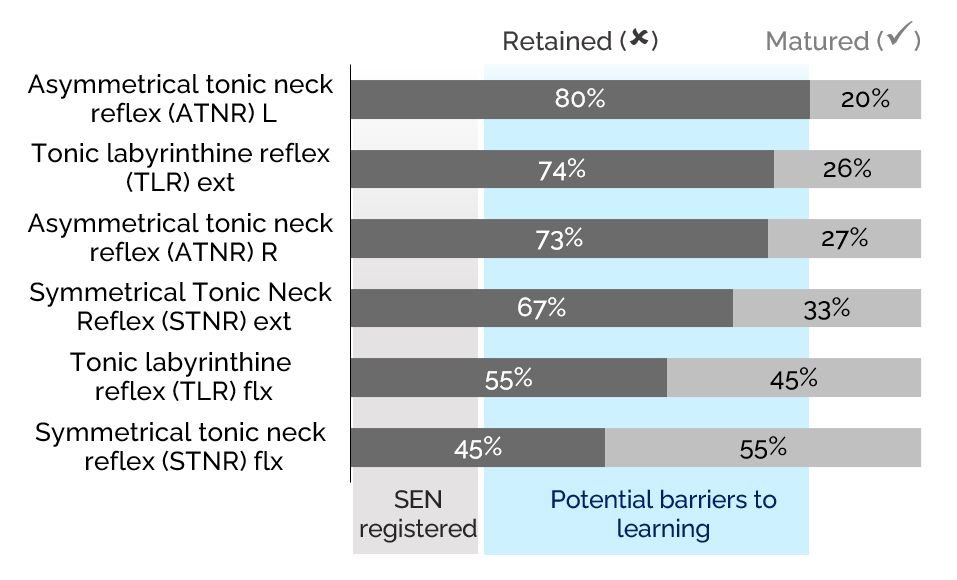
Up to 80% of children could have one or more primitive reflex retained to a certain degree.
This will potentially affect many more children than those who have been identified as having Special Educational Needs, as represented in this chart.